
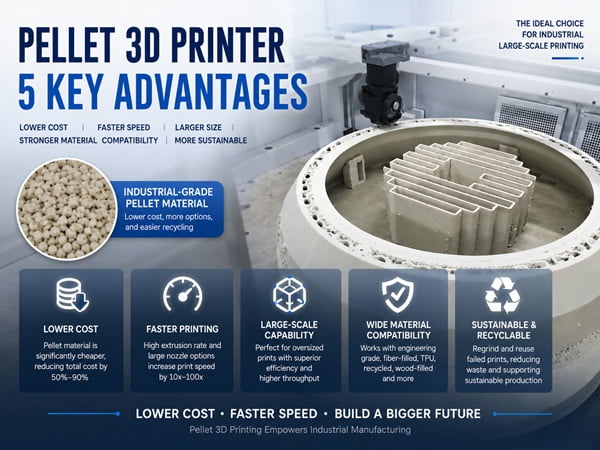
Is printing large objects too slow and expensive? Filament costs add up, limiting your biggest ideas. Pellet 3D printing offers a faster, much cheaper way to print big.1
Yes, pellet 3D printing is ready and is transforming industrial production. It uses raw plastic pellets instead of filament, drastically cutting material costs and printing time. This makes it perfect for manufacturing large-scale items like molds, furniture, and automotive prototypes quickly and affordably.
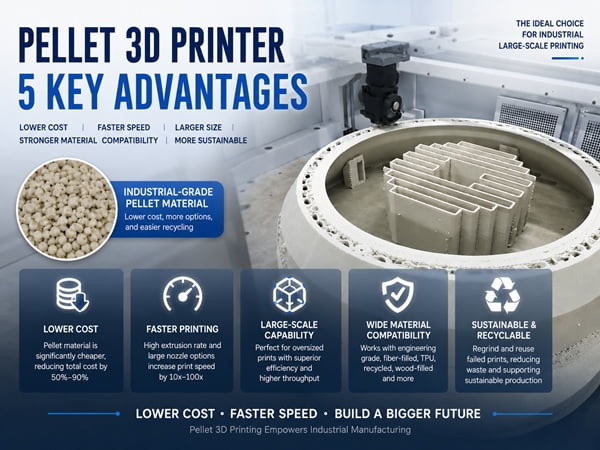
This technology is a game-changer, but you might be wondering how it all works. I've been in the CNC industry for over 27 years, and the shift to pellet printing is one of the most exciting I've seen. It’s a core part of our industrial 3D printer line at CHENcan CNC. Let's break it down, starting with the basics so you can see if it’s right for you.
What Is Pellet 3D Printing?
Does "3D printing" just mean filament to you? This common view misses a powerful industrial method. Pellet printing works directly with raw plastic granules, opening up new possibilities.
Pellet 3D printing is an additive manufacturing process that uses small, raw plastic pellets as its source material.2 Instead of melting a pre-made filament, the printer melts these pellets directly in an extruder and deposits them layer by layer to build an object.
This process is also known as Fused Granular Fabrication (FGF). Think of it this way: filament is just pellets that have been melted and shaped into a string. Pellet printing simply skips that entire expensive, time-consuming step. It uses the same raw material that goes into industrial processes like injection molding. The machine takes these plastic granules, or pellets, and processes them on the fly. Here is how it happens:
- Material Input: Raw pellets are loaded into a large container called a hopper.
- Extrusion: A heated screw inside the extruder melts the pellets and pushes them forward.
- Deposition: The molten plastic is forced out through a nozzle onto the build plate.
- Layering: The machine moves the print head, building the object one layer at a time.
This is a much more direct and industrial approach to 3D printing. It is designed for large-scale factory production, not for small desktop models. At my company, CHENcan CNC, our industrial 3D printers are built on this powerful and efficient technology.
How Does a Pellet 3D Printer Actually Work?
Does printing directly from raw pellets sound complicated? It's easy to imagine clogs and messy results. But the system is robust, using a screw mechanism for reliable material flow.
A pellet 3D printer works by feeding plastic granules from a hopper into a heated barrel. Inside, a rotating screw melts, mixes, and pressurizes the plastic, forcing it out of a nozzle. The machine's gantry system moves the nozzle to deposit the material layer by layer.
The mechanics are very similar to the extruder on an injection molding machine, but it's mounted on a CNC motion system. As a manufacturer of large gantry CNC machines for decades, this was a natural step for us. The stability of the gantry is critical for handling the heavy extruder and ensuring accuracy. Here are the key components and their jobs:
| Component | Function |
|---|---|
| Hopper | This container stores the raw plastic pellets. It often includes a dryer to remove moisture from the material before printing, which is crucial for quality. |
| Screw Extruder | This is the heart of the system. It's a rotating screw inside a heated barrel. It takes in solid pellets, melts them, mixes them for consistency, and pressurizes them for extrusion. |
| Heated Barrel | This surrounds the screw and has multiple heating zones. These zones allow for precise control over the melting process as the plastic moves toward the nozzle. |
| Nozzle | This shapes the molten plastic as it is deposited. Pellet printer nozzles are much larger than filament nozzles, which allows for very high material flow rates.3 |
| Gantry System | This is the motion system that moves the extruder in the X, Y, and Z directions to build the part. It must be extremely rigid to support the heavy print head. |
The rotation speed of the screw directly controls how much material comes out. This gives us precise control over the printing process, which is essential for large, high-stakes jobs.
Pellet vs. Filament: What’s the Real Difference?
Still buying expensive filament for your projects? The high cost and limited material choices can be a major roadblock. Pellets are the same plastic, just in their raw, much cheaper form.
The main difference is cost and form. Pellets are the raw industrial material, often 5 to 10 times cheaper than filament, which is just processed and spooled pellets. Pellets also offer a wider material variety, including custom composites and recycled plastics.
The differences between pellet printing and filament printing are huge, especially at an industrial scale. You are essentially cutting out the middleman who turns cheap pellets into expensive filament. This has a massive impact on your project's budget and timeline. Let's look at a direct comparison:
| Feature | Pellet 3D Printing (FGF) | Filament 3D Printing (FFF/FDM) |
|---|---|---|
| Material Cost | Very Low (e.g., $2-5 per kg) | High (e.g., $20-50+ per kg) |
| Print Speed | Extremely High (can exceed 100 kg/hr) | Low (typically under 0.1 kg/hr) |
| Material Variety | Almost Unlimited (any thermoplastic) | Limited to what is sold on spools |
| Hardware Cost | High (industrial machines only) | Low (desktop) to High (industrial) |
| Resolution | Lower (best for large parts) | High (best for small, detailed parts) |
| Material Handling | Requires hoppers and sometimes dryers | Simple and clean spool loading |
For our customers, like automotive design firms or foundry pattern makers, these differences are critical. Saving 90% on material costs and reducing print time from weeks to days provides an incredible competitive advantage. It changes what is possible to manufacture.
Why Are Pellet 3D Printers So Good for Large-Scale Printing?
Ever tried printing something huge with a regular 3D printer? It would take forever and cost a small fortune. Pellet printers are designed specifically for these massive-scale projects.
Pellet printers excel at large-scale printing due to two key factors: extreme speed and low material cost. Their screw extruders can output material hundreds of times faster than filament printers, and using raw pellets can reduce material expenses by up to 90%.
Let's put this into real numbers. Imagine one of our clients, a boat builder, needs a mold for a small hull that weighs 500 kg.
-
With a Filament Printer: A professional filament printer might extrude 50 grams per hour (0.05 kg/hr). Printing a 500 kg part would take 10,000 hours. That is over 416 days, or more than a year. At an average filament cost of $25/kg, the material alone would be $12,500. This is completely impractical.
-
With a CHENcan Pellet Printer: Our industrial pellet printers can easily extrude 25 kg per hour. The same 500 kg part would take just 20 hours to print. Using bulk pellets at $3/kg, the material cost would be only $1,500.
The project goes from impossible to being completed in a single day. This is why pellet printing is the only viable additive solution for truly large-scale objects. The high output rate requires an incredibly robust machine frame to handle the forces and maintain accuracy. Our experience building large gantry milling centers gives our printers the industrial-grade stability needed for this kind of work.
What Are Some Real-World Examples of Large Objects Printed with Pellets?
Is pellet printing just a cool theory? It can be hard to visualize its real-world impact. But companies are already using it to create huge molds, sculptures, and vehicle parts.
Real-world applications include large foundry patterns for casting metal parts, molds for composite manufacturing (like boat hulls and wind turbine blades), full-size automotive prototypes, custom architectural elements, and large-scale art installations.4
This technology is not for making small trinkets. It is used to produce functional, high-value items that are central to industrial processes. Here are some of the main applications we see among our clients:
-
Foundry Molds and Patterns: Companies like
m m castinig ltduse our machines to print large sand casting patterns. Instead of taking weeks to carve a pattern from wood, they can print it in a day or two. This drastically speeds up their ability to produce large metal parts for mining machinery or heavy equipment. -
Composite Tooling: The marine and aerospace industries rely on large molds to create composite parts. Clients like
Cleopatra BoatsandGurit Groupcan print full-size molds for boat hulls or wind turbine components, saving enormous amounts of time and labor compared to traditional methods. -
Automotive Prototyping: Automotive companies need to create full-size models and prototypes of car bodies and dashboards. Pellet printing allows them to go from a digital design to a physical model they can see and touch in a matter of days, which is invaluable for design validation.
-
Architecture and Art: We see artists and architects printing huge sculptures, custom furniture, and unique building facades. The technology gives them the freedom to create complex shapes at a massive scale that would be impossible or too expensive to make any other way.
How Does Using Pellets Give You More Material Flexibility?
Are you stuck with the limited plastics available as filament? This can stop you from using specialized or custom materials. With pellets, you can print almost any thermoplastic imaginable.
Pellets provide ultimate material flexibility because you are using the raw material direct from the chemical supplier. This allows you to print with high-performance composites (like carbon fiber-filled PEKK), custom color batches, or even your own recycled plastic flake.
Being free from the limitations of filament spools opens up a new world of materials. You are no longer limited to what a filament manufacturer decides to produce. This is a huge advantage for industrial applications.
-
High-Performance Polymers: You can print with materials like PEEK, PEKK, and PEI (Ultem). These plastics have incredible strength and heat resistance, making them perfect for aerospace and automotive parts. They are extremely expensive as filament but much more affordable as pellets.
-
Custom Composites: This is where it gets really interesting. You can create your own materials. You can buy a standard polymer like ABS or PETG and mix it with additives like carbon fiber, glass fiber, or wood fiber. This allows you to create a composite material with the exact properties you need—for example, extra stiffness from carbon fiber or a unique look from wood fiber.
-
Recycled Materials: This is a game-changer for sustainability and cost. A company can take its own plastic scrap from other manufacturing processes, grind it up into small flakes, and feed it directly into a pellet printer. This creates a closed-loop recycling system within the factory, reducing waste to zero and bringing material costs down even further.5
What Are the Technical Challenges of Pellet 3D Printing?
Does pellet printing seem too good to be true? You are right to be skeptical about the potential challenges. There are technical hurdles, but with the right equipment they are solvable.
The main technical challenges include managing moisture in the pellets, which can cause print defects, achieving consistent material feeding, and controlling the large thermal mass of the extruder. These systems also have lower resolution than filament printers.
To build trust with our clients, we are always honest about the challenges. Pellet printing is a powerful industrial tool, and like any industrial tool, it requires proper operation.
-
Material Drying: Many plastics, especially engineering-grade ones, absorb moisture from the air. If you try to print with wet pellets, the water turns to steam inside the hot extruder. This creates bubbles, voids, and weak parts. That is why professional systems like ours always include or recommend an industrial material dryer to prepare the pellets before printing.
-
Lower Resolution: To print fast, you need a big nozzle. Pellet printer nozzles can be 4mm to 16mm in diameter or even larger. This means you are printing very thick layers. The result is a part with a rougher surface finish and less fine detail. It's a trade-off: you get speed, but you lose resolution. This is why pellet printing is for large parts where a perfect surface isn't the main goal, or for parts that will be finished later with CNC machining.
-
Machine Cost and Size: These are large, heavy, industrial machines. They require significant investment and floor space. They are not for hobbyists or small shops. They are built for serious manufacturing environments where the return on investment comes from massive savings in time and material on large-scale projects.
How Do Pellet 3D Printers Control Oozing Without Retraction?
You know retraction is key for clean filament prints. But a massive screw can't just reverse. So how do you prevent a mess? Pellet printers use clever flow control techniques.
Pellet printers control material flow by precisely managing the screw's rotation.6 To stop flow during travel moves, the screw's rotation is stopped and sometimes even slightly reversed (called "suck back") to relieve pressure. Some systems use mechanical valves at the nozzle.
You can't just pull a column of molten plastic and solid pellets backward like you can with a thin filament. The physics are completely different. Instead, industrial pellet extruders use a few smart strategies to prevent the nozzle from oozing material during travel moves.
-
Screw RPM Control: The most direct method is simply controlling the screw's rotation speed (RPM). The amount of plastic coming out is directly tied to how fast the screw is turning. When the printer needs to move without printing, the control software tells the screw motor to stop completely.
-
Decompression or "Suck Back": To be even more precise, the screw can be reversed by a very small amount, maybe a fraction of a turn. This doesn't pull material back up, but it immediately relieves the pressure that has built up at the nozzle tip. This decompression is usually enough to stop the plastic from drooling out.
-
Mechanical Valves: The most advanced systems, which we use on our high-performance printers, may include a physical shut-off valve right at the nozzle opening. This is a small pin that can move to physically block the flow of plastic, providing a very clean start and stop.
-
Smart Toolpaths: The software also helps. It plans the printing path to minimize long travel moves across open space. Whenever possible, it will travel over areas that have already been printed, so if a tiny bit of material does ooze out, it just lands on the part itself.
When Should You Choose a Pellet 3D Printer—and When Should You Avoid It?
Is a pellet printer the right choice for you? Investing in the wrong technology can be a huge setback. Let's clarify when it makes sense and when another method is better.
A pellet printer makes sense for very large parts (over 1 cubic meter), high-volume production, or when using custom/recycled materials. It does not make sense for small, high-detail prototypes, one-off hobby projects, or when the initial investment cost is a primary barrier.
Choosing the right manufacturing technology is a critical business decision. A pellet printer is a specialized tool, and it's important to know if it fits your needs. Based on my experience helping hundreds of companies, here is a simple guide.
Choose a Pellet Printer When:
- Your parts are huge. We are talking about things you measure in meters, not millimeters. Think furniture, molds for boat hulls, or large architectural pieces.
- Speed is your top priority. You need to make large tools or prototypes in days, not months. Your business depends on moving quickly.
- Material cost is a major expense. You plan to print hundreds or thousands of kilograms of plastic. At this volume, the savings from using pellets will quickly pay for the machine.
- You need custom materials. You want to work with carbon fiber composites, recycled plastic, or other special blends that are not available as filament.
Stick with a Filament Printer When:
- You need fine details. You are printing small, intricate parts where high resolution and a smooth surface finish are most important.
- Your parts are small. For objects that can fit in your hand, the speed and cost benefits of pellet printing are not significant.
- Your budget is limited. The initial investment for an industrial pellet printer is much higher than for a desktop or even a professional filament printer.
- You need simplicity. Filament printing is generally easier to get started with and requires less technical knowledge about material handling.
So, Is Pellet-Based 3D Printing Really Ready for Industrial Production?
After weighing the pros and cons, is pellet printing just a niche, or is it truly ready? You need to know if it's a reliable choice. For industrial-scale work, it absolutely is.
Yes, pellet-based 3D printing is absolutely ready for industrial production. Companies worldwide are already using it to manufacture large tools, molds, and end-use parts, gaining major competitive advantages in speed, cost, and material choice. It is a proven technology.
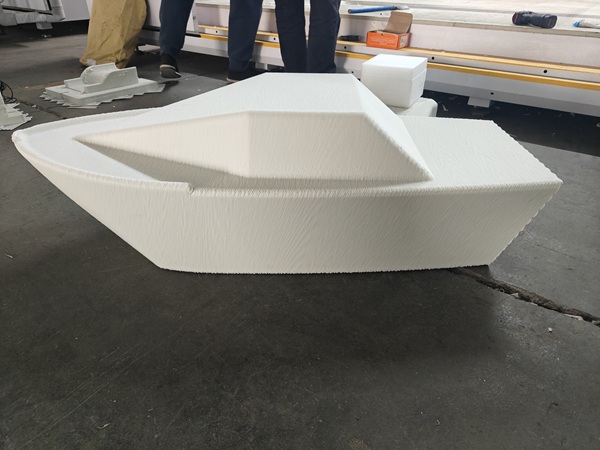
In my 27+ years in the machine tool industry, I have seen many technologies come and go. Pellet printing is not a fad. It is the logical next step for additive manufacturing at an industrial scale. It combines the cost-effective material handling of injection molding with the design freedom of 3D printing.
The proof is in the results our clients are achieving. We see companies like ats advanced tooling systems in the UK and Bolwell Holdings in Thailand using our machines to revolutionize how they make tools and prototypes. They are not just testing the technology; they are running their businesses on it.
The key is to see it as the right tool for the right job. It is not going to replace filament printers for small, detailed work. It is here to make large-scale additive manufacturing fast, affordable, and profitable. For the engineers, designers, and manufacturers who need to build big, pellet printing is not just "ready"—it is an essential tool for success.
Conclusion
Pellet 3D printing is a powerful tool for large-scale industrial use. It cuts costs and speeds up production, making it ideal for large molds, prototypes, and custom parts.
"Replacing PLA filament with PLA pellets using an extruder ... - Reddit", https://www.reddit.com/r/3Dprinting/comments/1obeil7/replacing_pla_filament_with_pla_pellets_using_an/. This source explains how pellet 3D printing reduces costs and increases speed compared to filament-based methods, particularly for large-scale projects. Evidence role: general_support; source type: research. Supports: Pellet 3D printing is faster and cheaper than filament-based 3D printing for large objects.. ↩
"Pellet 3D printing benefits compared to 3D filament extruders - Caracol", https://www.caracol-am.com/resources/knowledge-hub/pellet-3d-printing-benefits-compared-to-3d-filament-extruders. This source defines pellet 3D printing and explains its use of raw plastic pellets as the primary material. Evidence role: definition; source type: encyclopedia. Supports: Pellet 3D printing uses raw plastic pellets instead of filament as its source material.. ↩
"3D Printer Nozzles Explained - YouTube", https://www.youtube.com/watch?v=TmrSgCBXw_Q. This source describes how larger nozzles in pellet 3D printers enable higher material flow rates compared to filament printers. Evidence role: mechanism; source type: research. Supports: Pellet printer nozzles are larger, enabling higher material flow rates.. ↩
"JuggerBot 3D, ORNL to expand possibilities for pellet-fed ...", https://www.ornl.gov/news/juggerbot-3d-ornl-expand-possibilities-pellet-fed-3d-printing. This source provides examples of real-world applications of pellet 3D printing, including its use in manufacturing molds, prototypes, and large-scale art. Evidence role: case_reference; source type: research. Supports: Pellet 3D printing is used in industries like automotive, architecture, and art for large-scale applications.. ↩
"Closing the loop: Recycling PLA waste from 3D printing into value ...", https://bioresources.cnr.ncsu.edu/resources/closing-the-loop-recycling-pla-waste-from-3d-printing-into-value-added-filament-at-nc-state-university/. This source explains how pellet 3D printing can enable closed-loop recycling systems, reducing waste and material costs. Evidence role: mechanism; source type: research. Supports: Pellet 3D printing supports closed-loop recycling systems to minimize waste and costs.. ↩
"Screw-assisted 3D printing with granulated materials - PMC - NIH", https://pmc.ncbi.nlm.nih.gov/articles/PMC8169388/. This source explains how pellet 3D printers manage material flow through screw rotation and other techniques to prevent oozing. Evidence role: mechanism; source type: research. Supports: Pellet printers use screw rotation to control material flow and prevent oozing.. ↩