
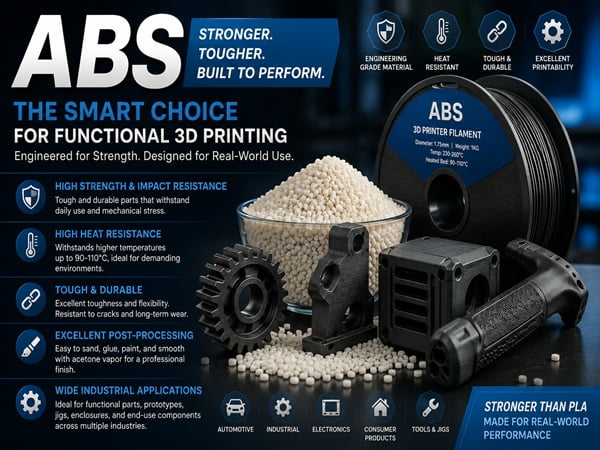
Is ABS Still the Best Choice for Your 3D Printing Projects?
Frustrated with prints that break or warp under stress? You need parts that are tough and heat-resistant, but common materials just aren't cutting it. ABS might be your answer.
Yes, for many applications, ABS is an excellent choice. It's a strong, durable, and temperature-resistant thermoplastic perfect for creating functional prototypes, end-use parts, and manufacturing aids. While it requires more specific printing conditions than PLA, its superior mechanical properties make it invaluable for demanding projects.
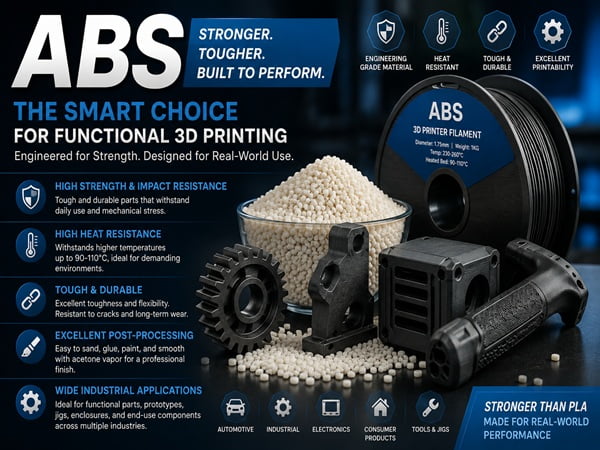
I've been working with CNC machines and advanced manufacturing for over 27 years, and I've seen countless materials come and go. But some materials, like ABS, have stood the test of time for a reason. They deliver performance where it matters most. In this article, I'll walk you through everything you need to know to master ABS, from its core properties to the best ways to print it successfully. Let's get started so you can make parts that last.
What Is ABS and Why Does It Remain a Key 3D Printing Material?
Are you wondering if older materials like ABS are still relevant? With so many new filaments on the market, it's easy to overlook this classic workhorse material.
ABS, or Acrylonitrile Butadiene Styrene, remains a key material because of its unmatched combination of toughness, heat resistance, and affordability. It delivers engineering-grade performance that hobbyist materials can't match, making it a reliable choice for parts that need to perform under real-world stress and strain.
In my experience, especially in industrial settings, reliability is everything. ABS has been a trusted plastic in manufacturing for decades1, used in everything from LEGO bricks to car dashboards. Its transition into 3D printing was natural because its properties were already well-understood and proven. While materials like PLA are great for quick prototypes or decorative items, they often fail when subjected to heat or repeated impacts. ABS steps in to fill that gap. It provides the durability needed for functional parts, jigs, fixtures, and enclosures that will actually be used. It's not the easiest material to print, but the results are worth the effort for any serious application.
How Is ABS Made and What Are Its Performance Advantages?
Ever wondered what gives ABS its unique strength and durability? The secret lies in its chemical makeup, which is more complex than simpler plastics like PLA.
ABS is a terpolymer created from three distinct monomers: Acrylonitrile, Butadiene, and Styrene. Each component provides a specific benefit, combining to create a material that is strong, tough, and easy to finish. This synergy is what gives ABS its performance edge over many other filaments.
Let's break down what each part does. The Acrylonitrile provides chemical resistance and thermal stability, meaning it holds up well against many oils and chemicals and doesn't deform easily under heat. The Butadiene is a rubbery substance that delivers toughness and impact resistance—it’s the reason ABS parts can take a hit without shattering. Finally, the Styrene provides a rigid structure and a nice, glossy finish.
At CHENcan CNC, we've even pushed this further. For our industrial pellet 3D printers, we use ABS reinforced with glass fiber or carbon fiber2. This creates a composite material with even greater strength and durability. When we print large molds or industrial models with this reinforced ABS, the final parts are incredibly tough and long-lasting, ready for demanding manufacturing environments.
What Are the Mechanical, Thermal, and Chemical Properties of ABS?
Need to know exactly how ABS performs under different conditions? Understanding its specific properties is crucial before you commit it to a functional part that needs to work reliably.
ABS offers a balanced profile of good mechanical strength, higher heat resistance than PLA, and solid chemical resistance. This makes it a versatile material suitable for parts that will face mechanical stress, moderate temperatures, and exposure to certain chemicals, unlike many standard 3D printing filaments.
To make it simple, I've put together a table comparing ABS to PLA, the most common 3D printing material. This really highlights why you'd choose one over the other for a specific job.
| Property | ABS (Acrylonitrile Butadiene Styrene) | PLA (Polylactic Acid) |
|---|---|---|
| Tensile Strength | Good (~40 MPa) | Moderate (~50 MPa) |
| Impact Resistance | Excellent (very tough and durable) | Low (brittle, shatters on impact) |
| Heat Resistance | Good (Glass Transition Temp. ~105°C) | Poor (Glass Transition Temp. ~60°C) |
| UV Resistance | Poor (becomes brittle in sunlight) | Poor (degrades in sunlight) |
| Chemical Resistance | Good against many oils, acids, and bases. | Limited (vulnerable to many common solvents) |
| Flexibility | Low (rigid but will bend before breaking) | Very Low (very rigid and snaps easily) |
As you can see, the standout feature of ABS is its impact resistance and heat tolerance. A part printed in PLA might deform if left in a hot car, but an ABS part will hold its shape. This is why we use it for automotive prototypes and functional machine components3.
Why Is ABS More Challenging to 3D Print Than PLA?
Heard that ABS is difficult to print and wondering why? The same properties that make ABS strong also create challenges during the printing process itself.
The main challenge with ABS is its high rate of thermal contraction. As it cools from its high printing temperature, it shrinks significantly. This shrinking process can cause the print to warp, lift off the build plate, and even crack between layers, leading to failed prints.
Think of it this way: when you print a large, flat object, the bottom layers start to cool while the hot nozzle is still printing the layers above. The bottom cools and shrinks, pulling the corners inward and up off the bed. This is warping. Similarly, if the air around the print is too cool, the temperature difference between the newly extruded layer and the one below it is too great. This stress can cause the layers to split apart, a problem known as delamination or cracking. On top of that, ABS printing releases fumes with a noticeable plastic smell (styrene), so you need good ventilation. PLA, on the other hand, shrinks very little and prints at lower temperatures, making it much more forgiving.
What Is the Essential Equipment for Printing ABS Successfully?
Are you ready to print with ABS but worried you don't have the right gear? A few key pieces of hardware can make the difference between a perfect part and a failed print.
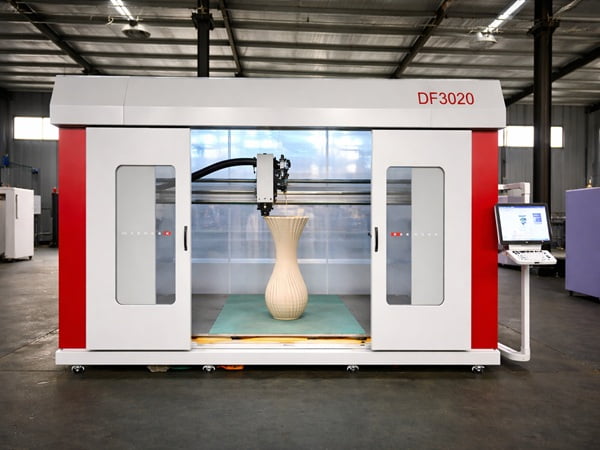
To print ABS successfully, you absolutely need a 3D printer with a heated build plate. A fully enclosed build chamber is also highly recommended to maintain a stable, warm ambient temperature and prevent warping. These two features are the most critical for managing ABS's thermal properties.
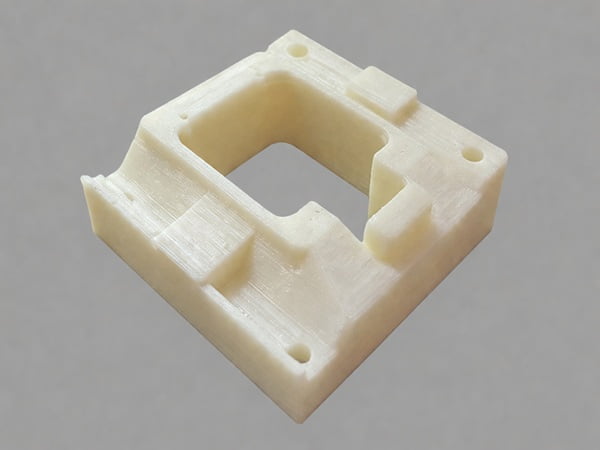
Let's look at the essential setup. First, the heated bed. This is non-negotiable. It keeps the bottom layers of your print warm and adhered to the surface, fighting the primary cause of warping. I recommend setting it to around 100-110°C. Second, an enclosure. This can be a built-in feature of the printer or a simple box you place over it. An enclosure traps heat from the heated bed, creating a warm chamber that slows the cooling of the entire part. This reduces thermal stress and prevents layer splitting. Finally, consider your build surface. A PEI sheet or glass bed with a glue stick or ABS slurry (ABS dissolved in acetone) provides excellent adhesion. With these three things—a hot bed, an enclosure, and a prepared surface—your success rate with ABS will skyrocket.
What Are the Best ABS Printing Parameters for Temperature, Bed, and Enclosure Setup?
Do you have the right equipment but are unsure about the specific settings? Dialing in your slicer settings is the final step to achieving great results with ABS.
The key to printing ABS is high heat and slow cooling. This means a high nozzle temperature (230-260°C)4, a very hot bed (100-110°C), and no part cooling fan for the first several layers, if at all. This combination ensures strong layer adhesion and minimizes warping.
I've printed thousands of ABS parts over the years, and these settings are my go-to starting point. Use them as a baseline and adjust based on your specific printer and filament brand.
| Parameter | Recommended Setting | Why It's Important |
|---|---|---|
| Nozzle Temp. | 230 - 260°C | Ensures the filament melts properly for strong bonding between layers. |
| Heated Bed Temp. | 100 - 110°C | Keeps the base of the print warm and stuck to the bed, preventing warping. |
| Enclosure | Maintain warm ambient temp. | Prevents drafts and rapid cooling, which cause layer splitting and cracking. |
| Part Cooling Fan | 0% for first 5-10 layers, then 20-50% max | Rapid cooling is the enemy of ABS. Turning the fan off or low prevents stress. |
| Print Speed | 40 - 60 mm/s | A moderate speed gives layers enough time to bond properly without cooling too fast. |
| Bed Adhesion | Brim or Raft | Increases the surface area of the first layer, providing extra hold to fight warping. |
Remember, consistency is key. Once you start an ABS print in an enclosure, try not to open the door. Maintaining that stable, hot environment is the secret to a successful, strong part.
What Are the Common ABS Printing Problems and How Do You Prevent Them?
Are you still running into frustrating failures like warping and cracking? Even with the right setup, a few common issues can pop up. Knowing how to fix them is crucial.
The most common ABS printing problems are warping, layer splitting (cracking), and poor bed adhesion. These are almost always caused by improper temperature management, specifically cooling the part too quickly. Preventing them requires a hot, stable printing environment.
After helping clients troubleshoot their manufacturing processes for years, I've found that breaking down the problem makes it much easier to solve. Here’s a quick guide to fixing the top three ABS issues.
1. Warping (Corners lifting off the bed)
- Cause: The bottom of the print is cooling and shrinking faster than the top, pulling the corners inward and upward.
- Solution: Increase your bed temperature to 110°C. Use a large brim (10-20 lines) or a raft in your slicer settings. Make sure your enclosure is sealed to maintain a high ambient temperature. An adhesive like a glue stick or ABS slurry can also help.
2. Layer Splitting / Cracking
- Cause: The temperature difference between the new, hot layer and the cooler layer beneath it is too large, causing stress that cracks the part along the layer lines.
- Solution: Turn your part cooling fan completely off, or set it to a very low speed (under 30%) only for overhangs and bridges. Increase your nozzle temperature by 5-10°C to promote better layer bonding. Ensure your enclosure is keeping the air around the print warm.
3. Poor Bed Adhesion
- Cause: The first layer isn't sticking properly to the build plate.
- Solution: Re-level your bed and ensure the nozzle is the correct distance from the plate (the "Z-offset"). Clean the build surface with isopropyl alcohol. Apply an adhesive like a glue stick, Magigoo, or a thin layer of ABS slurry.
What Are the Post-Processing Options for ABS 3D Printed Parts?
Is your printed part strong but the surface looks rough with visible layer lines? One of the best features of ABS is how easily you can post-process it for a professional finish.
ABS parts can be easily sanded, drilled, tapped, and painted. Most uniquely, they can be chemically smoothed using acetone vapor, which melts the outer surface to create a perfectly smooth, glossy finish that looks like an injection-molded part and improves strength.
This smoothing capability is a game-changer. While you can sand any print, it's a lot of work. With ABS, you can achieve a flawless surface with minimal effort. The process, known as acetone vapor smoothing5, involves placing the ABS part in a sealed container with a small amount of acetone. The acetone vapor melts the outer layer of the plastic, erasing layer lines completely. It also fuses the outer layers, which can increase the part's strength and make it watertight.
Safety First: Acetone is highly flammable and its fumes are hazardous. This process must be done in a well-ventilated area, away from any sparks or open flames, and with proper safety gear like gloves and goggles.
Beyond smoothing, ABS is also great for mechanical finishing. You can easily drill holes, tap threads directly into the plastic, or glue multiple parts together using acetone or a dedicated plastic cement. This makes it ideal for building complex assemblies.
What Are Typical Applications of ABS in Functional and Industrial Parts?
Wondering where ABS truly shines in the real world? Its strength and heat resistance make it the go-to material for parts that have a job to do.
ABS is widely used for creating durable functional prototypes6, custom manufacturing jigs and fixtures, protective enclosures for electronics, and end-use parts in the automotive and consumer goods industries. Its properties allow it to withstand mechanical stress and moderate heat in daily use.
In our 27+ years of providing CNC and 3D printing solutions, we've seen ABS used in countless demanding applications. Here are a few standout examples that showcase its capabilities:
- Automotive Prototyping: We create prototypes for interior components like dashboard panels, trim pieces, and air vents. ABS can handle the heat inside a car on a sunny day.
- Jigs and Fixtures: In our own production bases, we print custom jigs and fixtures from ABS to hold parts during machining or assembly. They are strong enough to withstand repeated use and are cheap to replace.
- Electronics Enclosures: ABS is perfect for housing circuit boards and other electronics. It's strong, provides good impact protection, and can be easily modified with drilled holes for wires and ports.
- Durable Molds: As I mentioned earlier, we use glass-fiber-reinforced ABS pellets to print large, durable molds for industries like boat building and automotive design. The strength and stability are essential here.
- Functional End-Use Parts: For special vehicles or custom machinery, we often print replacement parts or custom components like brackets, handles, and mounts directly in ABS.
These applications are where ABS proves its value over simpler materials.
When Should You Choose ABS—and When Is Another Material a Better Option?
Feeling overwhelmed by all the material choices? Knowing when to use ABS, and when not to, is key to getting the most out of your 3D printer.
Choose ABS when your part requires high impact strength, toughness, and moderate heat resistance. It is the ideal choice for functional parts that will be dropped, stressed, or used in warm environments. For simple visual prototypes or decorative items, PLA is often a better choice.
I always tell my clients to think about the part's final purpose. Let's make this really simple.
Choose ABS When:
- You are making a functional part that needs to be strong and durable (e.g., a tool handle, a mounting bracket, a gear).
- The part will be exposed to temperatures up to 100°C (e.g., components near a motor, parts for inside a car).
- The part needs to be impact resistant and able to take a hit without shattering (e.g., a protective case, a drone frame).
- You want a smooth, glossy finish and plan to use acetone vapor smoothing.
- You need to drill, tap, or glue the part as part of an assembly.
Choose Another Material (like PLA or PETG) When:
- You are printing a simple visual model or a decorative object where strength is not important.
- You are new to 3D printing and want an easy, forgiving material to learn with (choose PLA).
- Your printer does not have an enclosure or a reliable heated bed.
- The part will be used outdoors and exposed to UV sunlight for long periods (ASA is a better choice than ABS here).
- You need a food-safe part (choose PETG or a certified food-safe PLA).
By matching the material to the application, you save time, reduce frustration, and ensure your final part performs exactly as you need it to.
Conclusion
In short, ABS is a powerful, reliable material for any serious 3D printing project. With the right equipment and settings, you can create incredibly strong and durable functional parts.
"[PDF] History Of Plastics Injection Molding", https://people.tamu.edu/~hsieh/ICIA/Richland-Injection-Molding-Web/Richland-Part-1-History-of-Plastics.pdf. This source provides historical context on the use of ABS in manufacturing, including its applications in products like LEGO bricks and car dashboards. Evidence role: historical_context; source type: encyclopedia. Supports: ABS has been widely used in manufacturing for decades due to its proven properties.. ↩
"Optimization of Mechanical Properties in Carbon Fiber-Reinforced ...", https://ui.adsabs.harvard.edu/abs/2025JMEP..tmp..674T/abstract. This source discusses the use of reinforced ABS composites in industrial applications, highlighting their enhanced strength and durability. Evidence role: mechanism; source type: research. Supports: Reinforcing ABS with glass fiber or carbon fiber significantly enhances its strength and durability for industrial applications.. Scope note: The source may focus on specific industrial applications rather than general use cases. ↩
"Design and Simulation of an ABS Control Scheme for a Formula ...", https://www.academia.edu/65217210/Design_and_Simulation_of_an_ABS_Control_Scheme_for_a_Formula_Student_Prototype. This source discusses the use of ABS in automotive and machine component prototypes, emphasizing its heat resistance and durability. Evidence role: case_reference; source type: education. Supports: ABS is used in automotive prototypes and functional machine components due to its heat resistance and durability.. Scope note: The focus may be limited to specific industries like automotive and machinery. ↩
"Optimization of 3D printing process parameters to maximize the ...", https://ui.adsabs.harvard.edu/abs/2025JPhCS2972a2063M/abstract. This source provides recommended temperature settings for ABS printing, supporting the claim about optimal nozzle temperatures. Evidence role: statistic; source type: education. Supports: A nozzle temperature of 230-260°C is optimal for printing ABS to ensure proper layer bonding.. Scope note: The optimal range may vary slightly depending on specific ABS brands. ↩
"Investigating the Impact of Acetone Vapor Smoothing on the ...", https://pure.psu.edu/en/publications/investigating-the-impact-of-acetone-vapor-smoothing-on-the-streng. This source describes the acetone vapor smoothing process and its effects on ABS parts, including surface finish and strength improvement. Evidence role: mechanism; source type: education. Supports: Acetone vapor smoothing improves the surface finish and strength of ABS parts by melting the outer layer.. Scope note: The process may not be suitable for all ABS formulations or part geometries. ↩
"[PDF] Rotational Molding of Acrylonitrile-Butadiene-Styrene Polymers and ...", https://scholarsarchive.byu.edu/cgi/viewcontent.cgi?article=1111&context=etd. This source highlights the common industrial and functional applications of ABS, supporting its use in durable prototypes and manufacturing aids. Evidence role: case_reference; source type: education. Supports: ABS is widely used for creating durable functional prototypes, manufacturing jigs, and enclosures.. Scope note: The examples may not cover all possible applications of ABS. ↩