
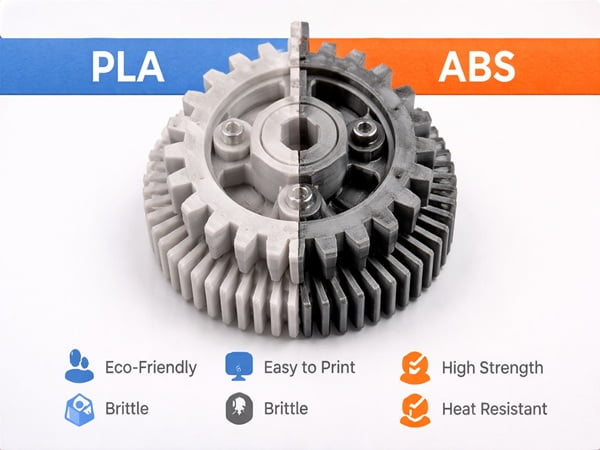
Struggling to choose the right 3D printing material1? The wrong choice can lead to failed prints and wasted time. Let's break down the two most popular options.
PLA is a user-friendly, biodegradable plastic2 perfect for detailed models and prototypes. ABS is a stronger, more durable thermoplastic3 ideal for functional parts that need to withstand heat and impact. Your choice depends entirely on how the final part will be used.
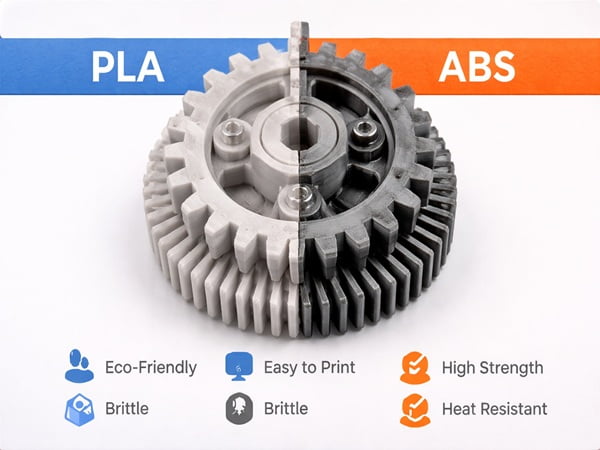
Choosing between PLA and ABS is one of the first big decisions you'll make in 3D printing. I've been in the manufacturing industry for over two decades, and I've seen countless projects succeed or fail based on this choice. Here at CHENcan CNC, we work with everything from small prototypes to large industrial molds, so we understand the practical differences. This guide will walk you through everything you need to know to make the right call for your project, so you can stop guessing and start printing with confidence.
What Are PLA and ABS? Material Basics Explained?
Confused about what PLA and ABS actually are? Using the wrong one can mean your part breaks or melts. Let's clear up the confusion from the start.
PLA (Polylactic Acid4) is a biodegradable polyester5 derived from renewable resources like corn starch or sugarcane. ABS (Acrylonitrile Butadiene Styrene6) is a common thermoplastic polymer made from petroleum. Think of PLA as the eco-friendly choice and ABS as the industrial workhorse.
Let's dive deeper into what these materials really are. It helps to understand where they come from to know how they'll behave.
The Origins of PLA and ABS
-
PLA (Polylactic Acid4): This material is plant-based. The process starts with fermenting a carbohydrate source like corn starch. This makes it biodegradable under the right industrial composting conditions. Because of its low printing temperature and non-toxic fumes, it has become the default material for hobbyists, schools, and anyone new to 3D printing. It's perfect for making things that will be used indoors and don't need to be super strong.
-
ABS (Acrylonitrile Butadiene Styrene6): This is a more traditional, oil-based plastic. It's the same stuff used to make LEGO bricks, car dashboards, and computer keyboard keys. Its strength comes from its three main components: Acrylonitrile for chemical and heat resistance, Butadiene for toughness and impact strength, and Styrene for a rigid structure and glossy finish. This composition makes it a go-to for real-world functional parts.
I remember a client who came to us to prototype a new line of decorative vases. We immediately recommended PLA. It printed the intricate designs flawlessly and was safe for indoor use. A week later, an automotive engineer needed a bracket for an engine bay test. For that, only ABS would do, as it could handle the heat and vibrations.
| Feature | PLA (Polylactic Acid4) | ABS (Acrylonitrile Butadiene Styrene6) |
|---|---|---|
| Origin | Renewable (Corn Starch, Sugarcane) | Petroleum-Based |
| Common Use | Hobbyists, Prototypes, Indoor Decor | Functional Parts, Automotive, Toys |
| Eco-Friendliness | Biodegradable (industrial) | Not Biodegradable |
PLA vs ABS: Mechanical, Thermal, and Chemical Properties Compared?
Does your part need to be tough, or just look good? Picking a material without knowing its properties is a recipe for disaster. Let's compare them head-to-head.
ABS is stronger, more flexible, and more resistant to heat and chemicals than PLA. PLA is stiffer and more rigid but can become brittle and will deform easily under heat. This makes ABS better for functional parts and PLA better for detailed, low-stress models.
The "better" material really depends on what you need the part to do. In our machine shops, we have to get this right every time. A foundry mold can't deform from heat, and a display model doesn't need the impact resistance of a car bumper. Let's break down the key differences that matter for your project.
Strength, Stiffness, and Durability
PLA is very rigid, which means it doesn't bend much. This is great for sharp corners and fine details, but it also makes it brittle. If you apply too much force, it will snap rather than bend. ABS, on the other hand, is more ductile. It has better impact resistance and will flex before it breaks. If you're printing a protective case for a phone or a part that might get dropped, ABS is the safer choice. For a statue or a piece of architecture model, PLA's rigidity is an advantage.
Thermal and Chemical Resistance
This is a major point of difference. PLA has a low glass transition temperature, around 60°C (140°F). This means a part left in a hot car on a summer day could warp and deform. ABS is much more resilient, with a glass transition temperature around 105°C (221°F). This is why it's used for automotive parts. Chemically, ABS also holds up better. It can be smoothed with acetone, while PLA is more susceptible to a wider range of chemicals but isn't easily smoothed with common solvents.
| Property | PLA | ABS | Winner for Industrial Use |
|---|---|---|---|
| Tensile Strength | High (but brittle) | Good (more ductile) | ABS |
| Impact Resistance | Low | High | ABS |
| Heat Resistance | Low (~60°C) | High (~105°C) | ABS |
| Chemical Resistance | Low | Good | ABS |
Heat Resistance and Durability: Which Material Performs Better?
Do you need a part that can survive in a hot environment or take a beating? A wrong choice here means your part could literally melt or shatter when you need it most.
For heat resistance and durability, ABS is the clear winner. Its ability to withstand higher temperatures (up to 105°C) and absorb impacts without breaking makes it far superior for any part that faces physical stress or heat, such as functional machine components or automotive parts.
In my line of work, performance under stress is everything. We can't have a custom jig or a prototype part fail on the factory floor because it got too hot or was accidentally dropped. This is where the engineering-grade properties of ABS truly shine and separate it from the more hobbyist-focused PLA. Let's examine exactly why this matters for real-world applications.
Surviving the Heat
The most critical factor here is the glass transition temperature (Tg). This is the temperature at which the plastic begins to soften and deform.
- PLA's Tg is around 60°C (140°F). This is surprisingly low. A PLA part left on a car dashboard, near a window with direct sunlight, or even close to hot electronic components can quickly lose its shape. It becomes soft and pliable, rendering it useless.
- ABS's Tg is much higher, around 105°C (221°F). This makes it reliable for parts used in electronics enclosures, automotive interiors, and even some low-stress engine bay components. It maintains its structural integrity in environments where PLA would fail completely.
Built to Last: Impact and Wear Resistance
Durability isn't just about heat; it's about handling physical stress.
- PLA is hard and rigid, but brittle. This means it has poor impact resistance. If you drop a PLA part, it's more likely to crack or shatter. Over time, it's also more prone to wear from friction.
- ABS is tougher and more ductile. The "butadiene" in its name is a type of rubber, which gives it the ability to bend and absorb impacts before fracturing. This is why it’s used for things like power tool housings and luggage. It can withstand repeated use, vibrations, and accidental drops much better than PLA. For any part that moves, gets handled frequently, or might be bumped, ABS is the more reliable material.
Ease of Printing: PLA vs ABS for Beginners and Professionals?
Just starting with 3D printing? The material you choose can be the difference between a perfect first print and a frustrating mess of plastic spaghetti on your print bed.
PLA is significantly easier to print than ABS, making it the ideal choice for beginners. It prints at lower temperatures, doesn't require a heated bed, and is much less prone to warping. Professionals often use PLA for quick prototypes because of its reliability and speed.
Every professional was once a beginner, and I remember my own early struggles with 3D printing. The simple truth is that getting a good print with ABS requires more hardware, more tuning, and more experience. PLA, on the other hand, is very forgiving. It allows you to focus on learning about design and slicing without having to troubleshoot constant print failures. Let's look at why PLA is so much friendlier to print with.
The Forgiving Nature of PLA
PLA is popular for a reason: it just works.
- Low Printing Temperature: PLA typically prints at a nozzle temperature of 190-220°C. This is within the range of almost every 3D printer on the market, even the most basic models.
- No Heated Bed Required: While a heated bed (around 50-60°C) can help with adhesion, it's not strictly necessary for PLA. You can get great results printing directly onto blue painter's tape or a PEI sheet at room temperature. This reduces the complexity and energy consumption of the print.
- Minimal Warping: PLA has a much lower coefficient of thermal expansion than ABS. This means it shrinks less as it cools, so the corners of your print are far less likely to lift off the bed and warp.
The Challenges of Printing ABS
ABS is a more demanding material, and it requires a more capable printer and environment.
- High Printing Temperature: ABS needs a higher nozzle temperature (230-260°C) and, crucially, a heated print bed (80-110°C). Without a hot bed, the print simply will not stick.
- Enclosure is Essential: To prevent warping and layer splitting, ABS must be printed in a heated, enclosed chamber. This keeps the ambient temperature stable, allowing the part to cool slowly and evenly. Many consumer printers are not enclosed, making successful ABS printing difficult without modifications.
For us at CHENcan, even with our industrial-grade machines, we choose PLA for initial design checks because it's fast and reliable. We only move to ABS when the part's functional requirements demand it.
Warping, Shrinkage, and Printing Environment Requirements?
Ever had a print peel up at the corners and ruin hours of work? This is called warping, and it's a huge problem if you don't manage your material and environment correctly.
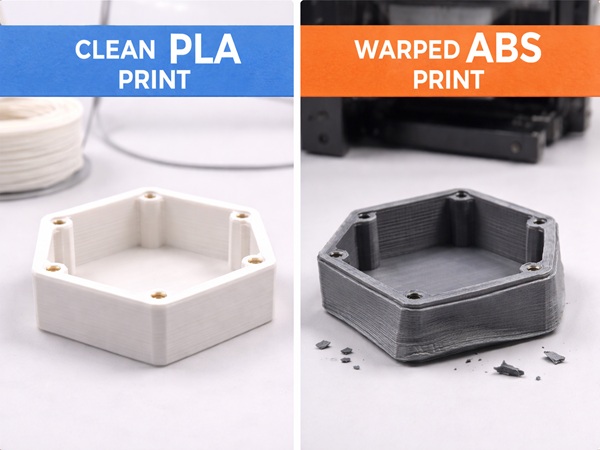
ABS is highly prone to warping and shrinkage because it contracts significantly as it cools. It requires a heated bed set to 80-110°C and a fully enclosed printer to maintain a stable, warm ambient temperature. PLA shrinks very little, making it resistant to warping.
Warping is one of the most frustrating issues in 3D printing. It happens when the upper layers of a print cool and shrink faster than the bottom layers, causing the edges to curl up and detach from the print bed. Understanding why this happens with ABS and not so much with PLA is key to achieving successful prints with both materials.
Why ABS Warps So Much
The root cause is thermal contraction. ABS needs to be printed at a high temperature, and the difference between its hot, extruded state and the cooler room temperature is large. As the plastic cools, it shrinks. The first layer is stuck to the hot bed, but subsequent layers pull inwards as they cool, creating immense stress that lifts the corners. To combat this, you absolutely need two things:
- A Heated Bed (80-110°C): This keeps the bottom layers of the print warm and adhered, reducing the temperature difference and the resulting stress.
- An Enclosure: This traps heat from the printer bed, creating a warm chamber (ideally 40°C or higher). This slows down the cooling of the entire part, allowing it to shrink more uniformly and preventing layers from splitting apart (delamination).
Why PLA is So Stable
PLA has a much lower rate of thermal contraction. The temperature difference between its printing temperature and the ambient air isn't as extreme, and the material itself is simply more dimensionally stable as it cools. This is why you can print PLA on an open-air printer without a heated bed and still get perfectly flat, sharp-cornered parts. For large, flat-bottomed objects, PLA is infinitely more reliable and less stressful to print than ABS. At our facility, when a client needs a large architectural model, we use PLA. Trying to print the same object in ABS would be a nightmare of warping and failed prints without a large-format, fully-heated chamber.
Surface Finish and Post-Processing Options (Sanding, Machining & Smoothing)?
Your print is done, but it's not finished. How can you take a rough, layered part and make it look like a professional product? The material you chose determines your options.
ABS offers superior post-processing options, including easy sanding and acetone vapor smoothing for a glossy, injection-molded finish. PLA is more difficult to sand, can be machined, but lacks a simple chemical smoothing method, often requiring fillers and primers for a smooth surface.
A raw 3D print has visible layer lines. For prototypes and especially for end-use parts, achieving a smooth surface is critical. In our work creating foundry patterns and automotive prototypes, post-processing is a standard part of the workflow. The ease of finishing ABS is a major reason it remains an industrial favorite.
Smoothing and Finishing ABS
ABS is the champion of post-processing.
- Sanding: ABS sands beautifully. It's soft enough that sandpaper smooths it down quickly without generating too much friction heat. You can progress through grits to get a very fine finish.
- Acetone Vapor Smoothing: This is the killer feature for ABS. By exposing an ABS print to acetone vapor in a controlled environment, the outer surface melts slightly. This process completely erases layer lines, resulting in a glossy, smooth surface that looks like it came from an injection mold. This is invaluable for creating professional-looking prototypes and enclosures.
- Machining: ABS is also easy to drill, tap, and machine, making it great for functional parts that need to be assembled with screws or other hardware.
The Challenges of Finishing PLA
Finishing PLA is more labor-intensive.
- Sanding: PLA is harder to sand than ABS. Its lower melting point means that the friction from sanding can quickly heat up and melt the plastic, causing it to gum up the sandpaper and create a messy surface. Wet sanding can help mitigate this.
- Chemical Smoothing: There is no common, safe solvent that works on PLA like acetone does for ABS. Some powerful chemicals like THF or Dichloromethane can work, but they are highly toxic and not recommended for general use.
- Filling and Painting: The most common method for smoothing PLA is to use a sandable filler primer. You apply a few coats, sand it smooth, and then paint the part. This is effective but requires multiple steps and a lot of manual labor.
Health, Safety, and Emissions: What You Should Know Before Printing?
Is 3D printing at your desk or in your workshop safe? The fumes released during printing are a serious concern, and the risks are very different for PLA and ABS.
Printing PLA is relatively safe, as it emits minimal odor and low levels of non-toxic VOCs (Volatile Organic Compounds). ABS, however, releases styrene, a hazardous VOC with a strong, unpleasant odor. Printing ABS requires excellent ventilation, ideally with an air filtration system.
Safety should always be the top priority in any workshop, including one with a 3D printer. When you melt plastic, it releases particles and fumes into the air you breathe. As someone who manages a production facility, I am very strict about air quality and ventilation. The difference between PLA and ABS in this regard is night and day.
The Low Risk of Printing PLA
PLA is derived from plants and is generally considered non-toxic. When melted, it releases a faint, slightly sweet smell that many compare to waffles. Studies have shown that while it does release some ultrafine particles (UFPs), it releases very low levels of VOCs. Because of this, printing PLA in a well-ventilated room (like a room with an open window) is widely considered safe. This is why it's the preferred material for schools, libraries, and home use where sophisticated ventilation systems are not available.
The Health Concerns of Printing ABS
ABS is a different story. It's a petroleum-based plastic, and when it melts, it off-gasses a variety of VOCs, most notably styrene.
- Styrene: This chemical is listed as a possible human carcinogen. Inhaling it can cause irritation to the respiratory system, eyes, and skin, as well as headaches and fatigue. The smell is strong and unpleasant.
- Ultrafine Particles (UFPs): ABS releases significantly more UFPs than PLA. These tiny particles can penetrate deep into the lungs and may pose long-term health risks.
Because of these emissions, you should never print ABS in an unventilated space. At a minimum, you need a room with active ventilation that exhausts fumes to the outdoors. The best practice, which we follow for all our industrial machines, is to use a printer with a full enclosure and an integrated air filtration system, such as a HEPA and activated carbon filter. This captures both the particles and the harmful VOCs before they enter your workspace.
PLA vs ABS Applications: Prototypes, End-Use Parts, and Industrial Use Cases?
What are you actually making? The purpose of your part—whether it's a quick model, a functional tool, or a product for sale—is the most important factor in choosing your material.
PLA is best for rapid prototyping, visual models, architectural mockups, and low-stress hobbyist prints. ABS is the preferred material for durable end-use parts, functional prototypes, automotive components, manufacturing jigs, and anything requiring high heat and impact resistance.
At CHENcan, we see the full spectrum of applications. Our clients come to us for everything from massive art installations to precision tooling for their factories. This experience has given me a very clear understanding of where each material excels. My initial insight holds true: PLA is for form, ABS is for function.
When to Use PLA
Choose PLA when the visual appearance and dimensional accuracy of a part are more important than its mechanical strength or heat resistance.
- Rapid Prototyping: When you need to quickly check the form, fit, and feel of a new design, PLA is perfect. It prints fast and reliably.
- Architectural and Design Models: PLA's ability to hold fine detail and sharp edges makes it ideal for creating detailed scale models of buildings or products.
- Hobbyist Prints and Crafts: For things like figurines, vases, and other decorative items that won't be exposed to stress or heat, PLA is the easy and safe choice. We often use it to create display models of our own CNC machines for trade shows.
When to Use ABS
Choose ABS when your part needs to perform a job, survive in a harsh environment, or withstand physical forces. This is where we use our industrial 3D printers the most.
- Functional Prototypes: If you need to test a part that will eventually be injection molded, printing it in ABS gives you a much better approximation of the final product's properties.
- End-Use Parts: For custom jigs, fixtures, and tools in a workshop, or for creating replacement parts for machinery, ABS has the necessary durability.
- Automotive and Electronics: From dashboard components and vents to enclosures for electronic devices, ABS's heat resistance and strength are essential. We frequently print casting molds and vacuum forming models from ABS for our industrial clients.
Cost Comparison: Filament, Pellets, and Production Economics?
Is PLA or ABS cheaper? The answer isn't just about the price per spool; it's about the total cost of production, including energy, machine time, and failed prints.
Standard PLA and ABS filaments are very close in price, typically costing $20-$30 per kilogram. However, for industrial production using pellets, ABS is often cheaper. The total cost of using ABS can be higher due to increased energy use and a higher failure rate without proper equipment.
As someone managing a manufacturing business, I look at cost from all angles. The sticker price of a material is just the beginning. The real cost includes everything it takes to turn that material into a successful part. Let's break down the economics for both hobbyists and industrial users.
Filament Cost for Hobbyists and Prototyping
For the average user buying 1kg spools of filament, the price difference between basic PLA and ABS is negligible. You can find both from reputable brands for about the same price. Specialty versions of PLA (like PLA+ or variants with carbon fiber) can be more expensive, but standard-for-standard, the cost is a wash. Where the cost difference appears is in the "hidden" costs:
- Energy Consumption: Printing ABS requires a constantly heated bed at a high temperature (80-110°C) and often a heated chamber. This uses significantly more electricity than printing PLA, which can be done with the bed off or at a low 60°C.
- Failed Prints: A beginner printing ABS on an open printer is likely to have a high failure rate due to warping. Every failed print is wasted material, time, and electricity. PLA's high success rate makes it more economical in this sense.
Pellets and Production Economics for Industrial Use
This is where the calculation changes. At CHENcan, our large-format industrial 3D printers use plastic pellets, not filament.
- Pellet Cost: In bulk quantities, ABS pellets are generally cheaper than PLA pellets. This makes ABS more attractive for mass production of parts where its properties are needed.
- Total Production Cost: While the raw material may be cheaper, the industrial machines needed to reliably print large ABS parts (with heated chambers and robust temperature control) are more expensive. However, for applications like foundry patterns or automotive parts, the superior performance of ABS justifies the cost. The economics of production scale up, making the material cost a more significant factor than the energy use per part.
PLA or ABS? How to Choose the Right Material for Your Project?
You've learned about properties, printing, and cost. Now it's time to decide. How do you weigh all these factors and make the final, confident choice for your specific project?
Choose PLA for ease of use, detailed visual models, rapid prototypes, and parts for low-stress, room-temperature environments. Choose ABS for functional parts that require strength, durability, ductility, and resistance to heat and impact, especially if you can post-process it.
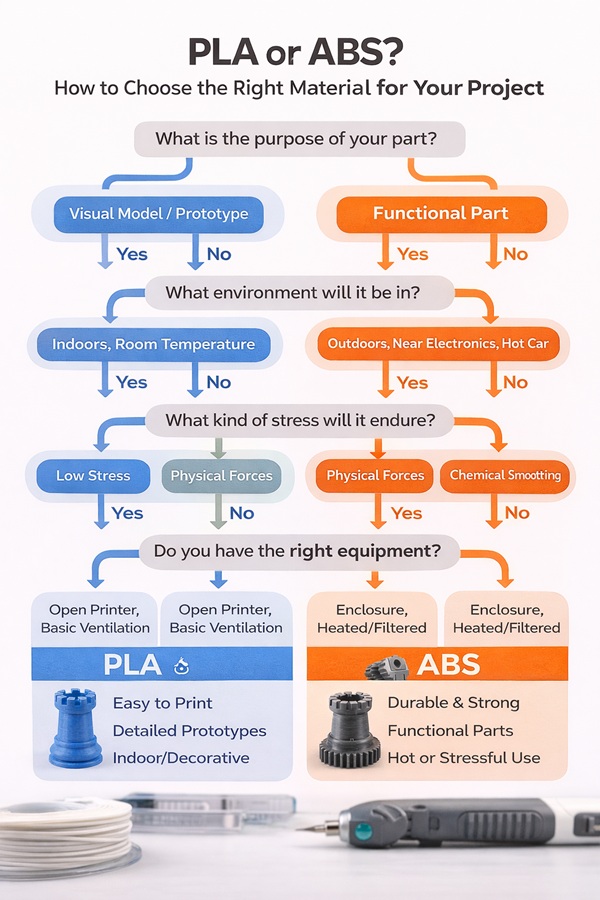
After years of guiding clients and running my own production, I've found that the best way to choose is to answer a few simple questions about your project. There's no single "best" material, only the "right" material for the job at hand. This decision-making process is what separates amateurs from professionals.
A Simple Checklist for Your Decision
Ask yourself these questions. Your answers will point you directly to the right material.
-
What is the part's primary purpose?
- Visual Model/Prototype: Does it just need to look right? (→ PLA)
- Functional Part: Does it need to perform a mechanical task? (→ ABS)
-
What environment will the part be in?
- Indoors, Room Temperature: Will it sit on a desk or shelf? (→ PLA)
- Outdoors, Hot Car, Near Electronics: Will it be exposed to temperatures above 50°C (122°F)? (→ ABS)
-
What kind of stress will the part endure?
- Low Stress/Static: Will it be a static display piece? (→ PLA)
- Impacts, Bending, Vibration: Will it be dropped, bent, or used in a machine? (→ ABS)
-
How important is surface finish?
- Layer lines are acceptable, or I can fill/sand/paint: Is a perfect finish a "nice to have"? (→ PLA)
- I need a glossy, smooth, injection-molded look: Is a professional finish critical? (→ ABS, with acetone smoothing)
-
What are my equipment and safety capabilities?
- Open-air printer, standard room ventilation: Do I have a basic setup? (→ PLA)
- Enclosed printer with ventilation/filtration, heated bed: Do I have an advanced setup? (→ ABS)
By walking through this checklist, you can move from uncertainty to a clear, justified material choice for any project you tackle.
Conclusion
In short, choose PLA for its ease of printing and fine detail, perfect for models. For durable, heat-resistant functional parts needed in industry, ABS is the superior, professional choice.
Understanding the best materials for 3D printing can enhance your projects and prevent failed prints. ↩
Learn why PLA is favored for detailed models and prototypes, especially for beginners in 3D printing. ↩
Discover the benefits of using ABS for functional parts that require heat and impact resistance. ↩
Gain insights into the eco-friendly nature and applications of PLA in various industries. ↩
Learn about the environmental benefits and applications of biodegradable polyester like PLA. ↩
Understand the industrial applications and benefits of ABS in creating durable parts. ↩