
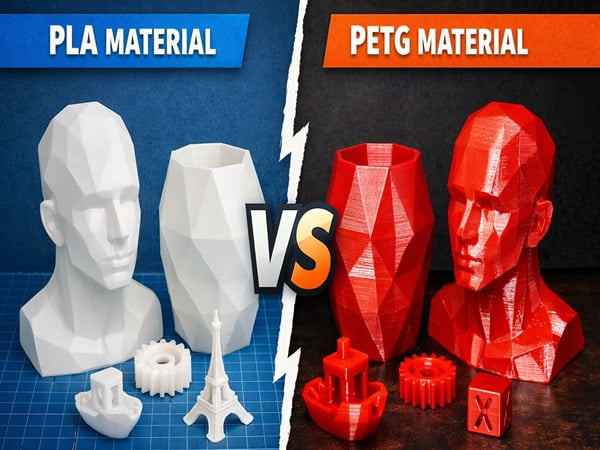
PLA vs PETG: Which 3D Printing Material is Best for Your Project?
Choosing the wrong 3D printing material1 can ruin your part and waste hours of machine time. Are you tired of failed prints and broken parts2? Let us fix that.
PLA is best for quick visual prototypes3 and display models due to its ease of printing. PETG is the clear winner for structural parts4, long-term outdoor use, and functional prototypes because it offers higher strength, better heat resistance, and excellent durability.
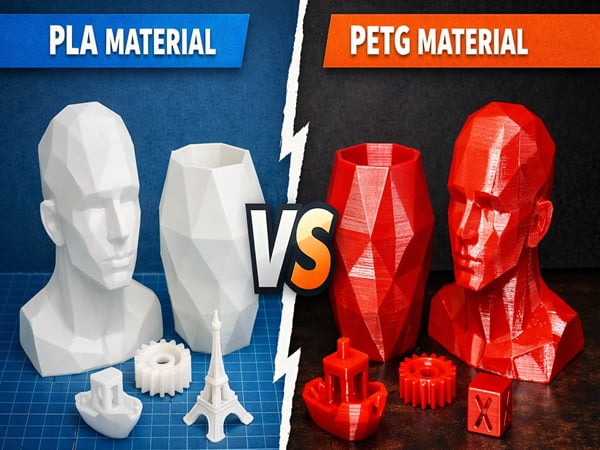
I have spent years working with industrial 3D printers at CHENcan CNC. I see engineers struggle with material choices every day. Let us look at how PLA and PETG really compare in real-world engineering.
PLA vs PETG at a Glance: What Are the Key Differences You Need to Know?
You need a fast answer to pick a material. Picking blindly leads to weak parts. Here is the direct comparison you need.
PLA prints easily at lower temperatures and is very rigid but brittle. PETG needs higher heat but gives you strong layer adhesion, impact resistance, and flexibility. Choose PLA for looks and PETG for tough jobs.
When we talk about material choice, we must think about structural performance versus display needs. I always ask my clients: "Will this part take a load?" If the answer is yes, PLA is usually a bad idea. PLA is stiff. It holds fine details well. But it snaps easily under pressure. PETG bends before it breaks. This makes it a true engineering material.
Short-Term vs Long-Term Use
For short-term design checks, PLA saves you time. It prints fast and almost never warps. But for long-term use, especially in a factory or outdoors, PETG wins. PETG does not degrade quickly. It handles moisture and daily wear.
Quick Comparison Table
| Feature | PLA | PETG |
|---|---|---|
| Best Use | Visual models, quick tests | Functional parts, fixtures |
| Strength | High stiffness, brittle | Good impact, tough |
| Lifespan | Short-term | Long-term |
| Ease of Print | Very easy | Moderate |
In my experience at CHENcan CNC, choosing between these two materials sets the baseline for your production efficiency.
Material Composition Explained: Biodegradable PLA vs Modified PETG?
Do you know what goes into your printer? Using the wrong chemical base causes long-term part failure. Let us break down what these plastics actually are.
PLA is made from plant starches like corn, making it eco-friendly and biodegradable under industrial conditions. PETG is standard PET plastic modified with glycol to prevent crystallization, making it clear, tough, and highly chemical resistant.
Understanding the chemistry helps you predict how a part will act in the real world. PLA (Polylactic Acid) is a bioplastic. It is great for the environment. But this organic nature means it breaks down over time. It absorbs moisture slowly. It loses its strength in a few years.
Why Glycol Matters in PETG
PETG stands for Polyethylene Terephthalate Glycol. The "G" is very important. Regular PET gets brittle when you heat it. Adding glycol stops this. It keeps the plastic tough and clear during the printing process.
Production Efficiency Impact
| Material | Chemical Base | Key Engineering Trait | Long-Term Stability |
|---|---|---|---|
| PLA | Plant starch | Rigid structure | Low |
| PETG | Petroleum | Chemical resistance | High |
When we run our large industrial pellet 3D printers at CHENcan CNC, we must think about these bases. PETG gives us the long-term stability needed for automotive prototypes and mold patterns. PLA is strictly for quick visual checks.
Printing Difficulty Compared: Which Is Easier for Beginners and Pros?
Failed prints waste time and money. Struggling with bed adhesion is frustrating. Let us see which material gives you fewer headaches on the machine.
PLA is the easiest material to print because it does not warp and needs no enclosure. PETG is harder. It sticks too much to the bed, strings often, and requires careful tuning of retraction settings to get clean results.
Production efficiency relies on machine uptime. If you spend hours tuning a machine, you lose money. PLA flows smoothly. It rarely clogs. You can print it fast. For a beginner or a busy shop making display models, PLA is a dream.
The Challenge with PETG
PETG is sticky. This is great for layer strength, but bad for clean prints. It oozes out of the nozzle. You will see fine hairs or "stringing" on your parts. You must spend time tuning your machine to print PETG well.
Tuning for Success
| Setting Area | PLA Difficulty | PETG Difficulty |
|---|---|---|
| Bed Adhesion | Easy, uses simple glue | Hard, can tear glass |
| Stringing Control | Very easy | Requires careful tuning |
| Print Speed | Fast | Slow to medium |
As an engineer, I accept the difficulty of PETG because the final part is worth it. But if I just need a quick shape check for a new CNC router design, I always load PLA.
Temperature, Bed, and Chamber Requirements?
Cold rooms ruin big prints. Wrong temperatures cause weak layers. Getting the heat right is the secret to strong structural parts.
PLA prints well at 190-220°C with a cool bed (50-60°C) and no chamber. PETG needs higher heat at 230-250°C and a hot bed (70-90°C). Neither requires a fully heated chamber, but PETG benefits from stable room temperatures.
Temperature directly controls structural performance. If the plastic is too cold, the layers will not bond. This creates weak points. PLA is very forgiving. It melts at low heat. You can leave the printer door open. You do not need expensive heated beds.
Heat and Layer Bonding
PETG demands respect for heat. You must push the nozzle temperature5 up. This high heat allows the PETG layers to melt into each other. This creates a part that acts almost like a single solid piece of plastic.
Hardware Needs
| Requirement | PLA | PETG |
|---|---|---|
| Nozzle Temp | 190°C - 220°C | 230°C - 250°C |
| Bed Temp | 50°C - 60°C | 70°C - 90°C |
| Enclosure | Not needed | Recommended for drafts |
| Cooling Fan | 100% on | 30% - 50% on |
In our CHENcan CNC factory, our industrial 3D printers have controlled environments. But even on a desktop machine, you must manage drafts when printing PETG to ensure long-term stability in your functional parts.
Mechanical Properties: How Do Strength, Flexibility, and Durability Compare?
Broken parts can cause accidents. Stiff plastics snap without warning. You must match the mechanical property to the real-world job.
PLA has high tensile strength but is very brittle and shatters under heavy impact. PETG is slightly softer but highly durable, offering excellent impact resistance and enough flexibility to bend under stress instead of breaking instantly.
This is where engineering judgment is critical. People often think "strong" means "stiff." PLA is very stiff. It can hold a heavy static load. But in the real world, parts get dropped. They experience vibrations. When a PLA part hits the floor, it shatters into pieces.
The Value of Flexibility
PETG has better long-term stability because it can absorb energy. It bends slightly under pressure. We call this impact resistance. For functional prototypes, like drone frames or robot arms, this bending saves the part from total failure.
Property Breakdown
| Mechanical Trait | PLA | PETG |
|---|---|---|
| Tensile Strength | High | Medium-High |
| Impact Resistance | Low (shatters) | High (bends) |
| Layer Adhesion | Good | Excellent |
| Wear Resistance | Poor | Good |
When we make custom fixtures for our 5-Axis Machining Centers, we always use materials like PETG or stronger. PLA is just too risky for factory floor tools.
Heat, Water, and UV Resistance Performance?
Sun and water destroy weak plastics fast. Melting parts ruin expensive projects. You must know how your material handles the outside world.
PLA deforms quickly in hot cars (around 55°C) and degrades under UV light and moisture. PETG handles heat up to 80°C, is highly water-resistant, and survives direct sunlight for years, making it perfect for outdoor applications.
Long-term use depends entirely on environmental resistance. I have seen clients print beautiful PLA parts, put them in a hot car, and find a melted puddle two hours later. PLA has a very low glass transition temperature. It gets soft at just 55 degrees Celsius.
Surviving the Elements
PETG is an engineering grade material because it survives real weather. It resists water completely. It does not turn yellow or crack under the sun's UV rays quickly. It can handle boiling water temperatures without losing its shape.
Environmental Data
| Environment | PLA Performance | PETG Performance |
|---|---|---|
| Heat Deflection | ~55°C (Fails in cars) | ~80°C (Survives heat) |
| Water Exposure | Absorbs, swells over time | Waterproof, stable |
| UV/Sunlight | Degrades, gets brittle | Highly resistant |
For outdoor sensor boxes, automotive parts, or marine applications like shipbuilding molds we work with at CHENcan CNC, PETG is the absolute minimum requirement. PLA has no place outdoors.
Surface Finish and Post-Processing: Sanding, Painting, and Supports?
Ugly parts make your brand look bad. Hard-to-clean supports slow down your work. Knowing how to finish a part saves hours.
PLA gives a matte, smooth finish that is very easy to sand, paint, and remove supports from. PETG has a glossy finish, but it is gummy and hard to sand. PETG supports stick tightly and are difficult to remove cleanly.
Production efficiency is not just about print time. It includes post-processing. If you spend three hours sanding a part, your efficiency is terrible. PLA is the king of display purposes. It sands easily to a glass-like finish. Primer and paint stick to it perfectly.
The Problem with Finishing PETG
PETG resists your efforts to smooth it. Because it is chemically resistant and tough, sandpaper just pushes the plastic around. It feels gummy. Paint does not want to stick to its glossy surface. Support structures often fuse to the main part.
Post-Processing Guide
| Finishing Task | PLA | PETG |
|---|---|---|
| Support Removal | Easy, snaps off cleanly | Hard, leaves marks |
| Sanding | Easy, creates dust | Difficult, gets gummy |
| Painting | Excellent base | Needs special primer |
| Gluing | Superglue works well | Hard to glue |
If the goal is a beautiful architectural model or an automotive design concept to show a client, use PLA. If the goal is a hidden structural bracket, use PETG and ignore the ugly finish.
Safety, Odor, and Environmental Impact?
Toxic fumes harm your workers. Piles of plastic waste hurt the earth. Safety and impact matter just as much as part strength.
Both PLA and PETG are generally safe and produce very little odor during printing. PLA is slightly safer as it comes from plants and smells sweet. PETG is petroleum-based and recyclable, but neither emits dangerous toxic fumes like ABS does.
As a factory manager, I care deeply about worker safety. Airborne particles from 3D printers can be a hazard. Thankfully, both PLA and PETG are safe choices for an open office or factory floor. PLA smells like warm syrup. PETG has almost no smell at all.
The Biodegradable Myth
Many people think PLA will melt away in their garden. This is false. PLA only breaks down in industrial compost facilities with high heat and microbes. However, its plant-based origin makes its carbon footprint smaller. PETG is a standard plastic. But it is highly recyclable (Resin ID 1).
Safety Comparison
| Factor | PLA | PETG |
|---|---|---|
| Fumes (VOCs) | Very low | Very low |
| Odor | Sweet, mild | None to mild |
| Source Material | Corn/Sugarcane | Petroleum |
| End of Life | Industrial compost | Recyclable |
At CHENcan CNC, we use huge industrial 3D printers. Even with massive pellet extruders, PLA and PETG keep our air quality safe compared to nasty materials like ABS or Nylon.
Best Applications for PLA vs PETG: Functional vs Aesthetic Parts?
Using the wrong plastic ruins the end product. Stop guessing what to use. Let us match the material to the actual industry job.
Use PLA for aesthetic models, architectural mockups, tabletop miniatures, and short-term fit tests. Use PETG for functional engineering parts, liquid containers, outdoor enclosures, automotive brackets, and custom factory jigs that need long-term durability.
This is the final engineering judgment. You must separate structural uses from display uses. Short-term versus long-term. PLA shines when you need to check the shape of a part before CNC machining it. We call this form-and-fit testing. It is fast, cheap, and precise.
Heavy Duty Engineering
PETG steps in when the part goes to work. If I need a custom dust shoe for a CNC Router, I print it in PETG. It will face flying wood chips, heat, and vibration. PLA would break in a day.
Application Matrix
| Industry Application | Recommended Material | Reason |
|---|---|---|
| Foundry Pattern Making | PLA | Fast, sands easily for molds |
| Automotive Brackets | PETG | Handles engine heat, tough |
| Exhibition Sign Making | PLA | Looks great, paints well |
| Custom Factory Jigs | PETG | High impact resistance |
Our clients in wind turbine manufacturing and shipbuilding always test their large-scale designs. They use PLA for the desk models. They use PETG for the actual assembly fixtures.
PLA or PETG: Which One Should You Choose for Your Project?
You have all the facts now. It is time to make a choice. Let us summarize the best path for your exact engineering needs.
Choose PLA if you want fast, easy, and beautiful prints for visual projects and indoor use. Choose PETG if you need strong, heat-resistant, and tough parts for outdoor use, mechanical tasks, or long-term structural stability.
Your choice dictates your production efficiency. Do not force a material to do a job it was not made for. If you run a design studio, PLA is your main tool. It saves machine time and looks professional.
The Final Engineering Call
If you run a manufacturing floor, PETG is your workhorse. The extra time spent tuning the printer pays off in parts that last for years. Think about the total lifecycle of the part. A broken PLA bracket costs you more in downtime than the extra hour it takes to print it in PETG.
Decision Checklist
| Question | If Yes, Choose... |
|---|---|
| Does it hold weight or take impacts? | PETG |
| Will it be painted or sanded? | PLA |
| Will it live outside or in a car? | PETG |
| Is it just a visual prototype? | PLA |
At CHENcan CNC, we help our clients optimize their entire production line. Whether you use 5-Axis machines or Industrial 3D Printers, picking the right material is step one to success.
Conclusion
PLA is perfect for quick, beautiful display models. PETG is the tough choice for long-term structural engineering. Match the material to your goal for the best production results.
Understanding the best materials for 3D printing can save time and improve the quality of your projects. ↩
Learn how to avoid common 3D printing issues to save time and resources. ↩
Discover why PLA is a preferred choice for creating quick and effective visual prototypes. ↩
Explore the benefits of using PETG for creating durable and strong structural parts. ↩
Find out the optimal nozzle temperatures to ensure successful 3D prints with PLA and PETG. ↩