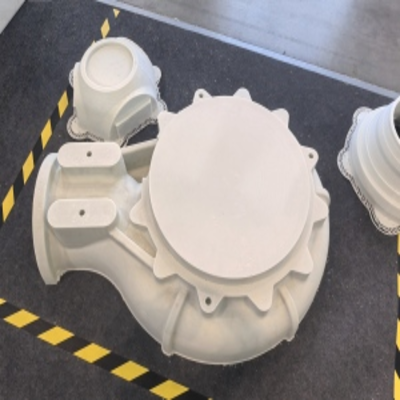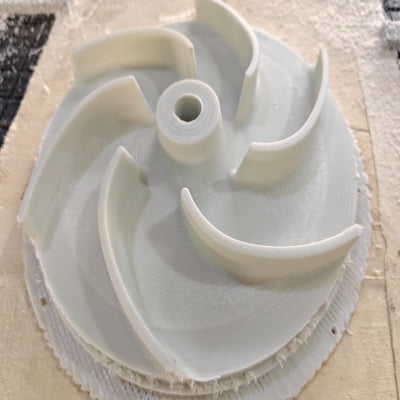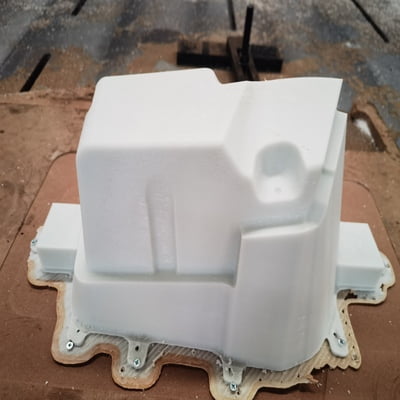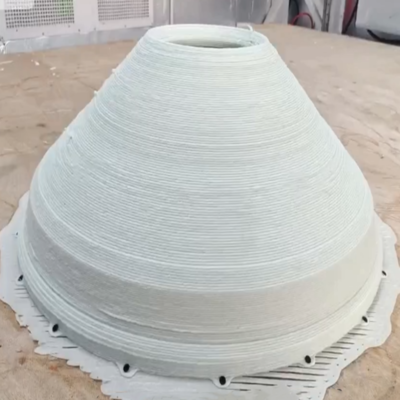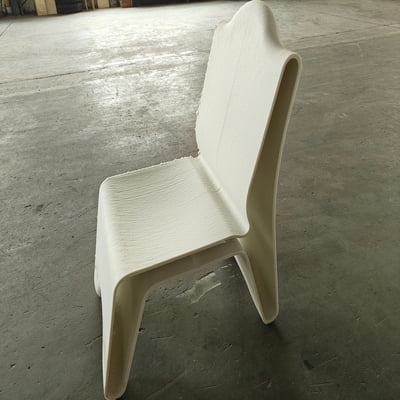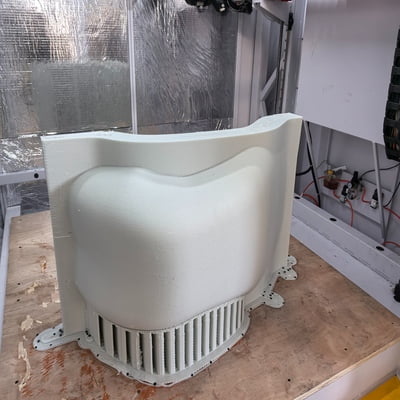
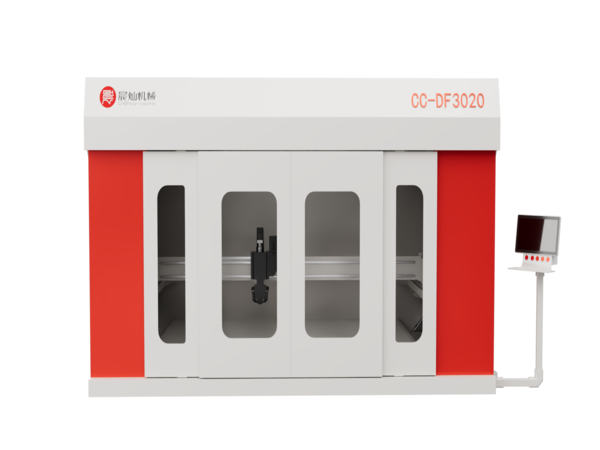
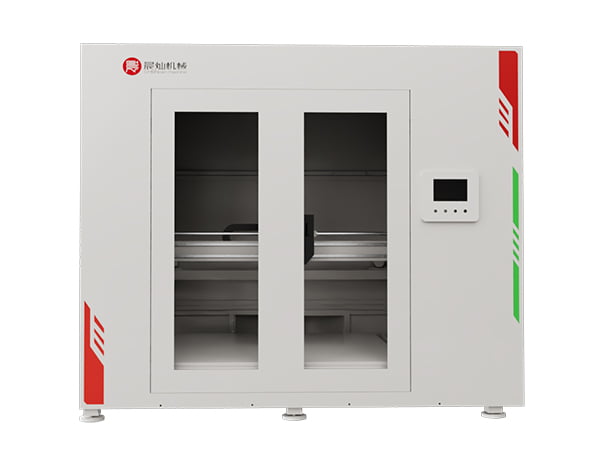
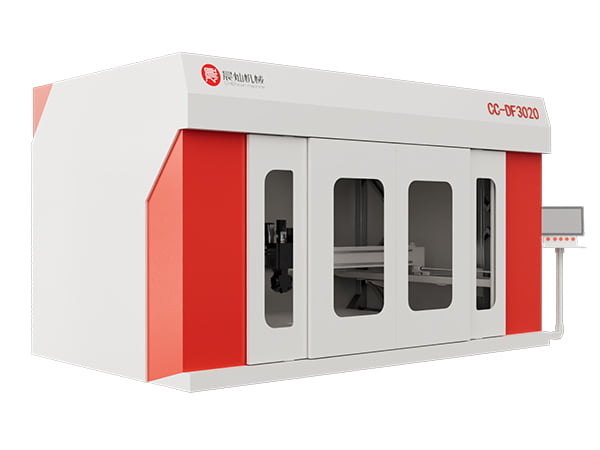
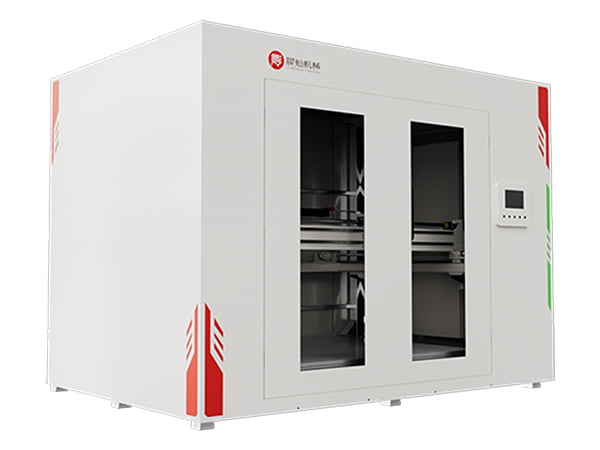
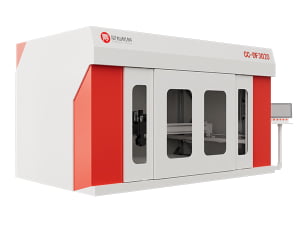
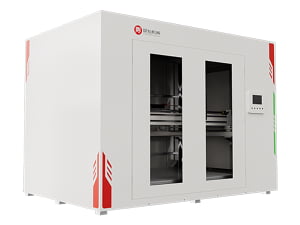
The DF Series Industrial 3D Printer is a pellet-based additive manufacturing system designed for large-scale industrial parts and rapid prototyping.
Using plastic granules instead of filament, this industrial 3D printing solution delivers higher efficiency, larger build size, and significantly lower material cost, making it ideal for industrial production and functional tooling.
This machine is widely used in mold making, sand casting patterns, automotive interior tooling, outdoor sculptures, and industrial design prototyping, offering a modern alternative to traditional CNC machining and manual mold manufacturing.
Key Advantages of Industrial Pellet 3D Printing:
1. Cost Reduction & Higher Efficiency: Compared with traditional manufacturing methods, pellet-based 3D printing significantly reduces material and labor costs; No highly skilled operators are required, and production efficiency is greatly improved.
2. Ideal for Mold Making: Plastic molds printed by this system are More durable than wooden molds, Not easy to deform, Up to 2× longer service life than wood molds. This makes it an excellent solution for sand casting molds, foundry patterns, and prototype tooling.
3. Large Build Size & High Output: Compared with filament 3D printers, CHENcan 3d printer with Larger printing dimensions, Higher extrusion rate, Shorter production cycle for large parts.
4. Excellent Alternative to Traditional Processes: This industrial 3D printer replaces Manual woodworking, CNC rough machining, Metal mold fabrication (for non-load-bearing applications), Resulting in faster lead times and lower total manufacturing cost.
5. Suitable for Composite & Functional Parts: Composite pellet materials provide Better structural stability, Improved strength, Long-term dimensional consistency.
Technical Specification of 3D Printer:
| Project | Item | Value / Note |
| Screw Extrusion System | Screw Diameter | 20mm |
| Max. Heating Temperature | 350 degrees | |
| Raw Materials | Pellet | |
| Extrusion Motor | Servo | |
| Max. Output | 8Kgs | |
| Control System | CHENcan CNC Controllor | With USB / WIFI / Elthernet |
| Slicing Software | Cura | Optional: Orca / Simplify 3D |
| File Formats | 3d Drawing | STL / OBJ / 3MF |
| Nozzle Diameter | 2mm-5mm | 2mm-10mm for 12KGS Output Head |
| Repeatabiliy Accuracy | XYZ | +/- 0.15mm |
| Working Speed | XY | 200mm/s |
| Z | 10mm/s | |
| Automatic Feeding Sytem | Yes | With 100KGS Hopper Dryer |
| Others | Air Pressure | 0.6-0.8 kgf/cm2 |
| Total Power | 4KVA | |
| Voltage | 220V 3P / 380V 3P |
Typical Industries & Applications of 3D Printing:
1. Plastic molds replacing wooden molds for sand casting patterns
2. Automotive interior molds, replacing traditional metal vacuum forming molds.
3. Large outdoor sculptures, with UV-resistant surface treatment for long-term durability.
4. Industrial Design & Rapid Prototyping.
5. Architecture, Building & Decoration.
6. Furniture & Interior manufacturing.
7. Composite-reinforced pellets (glass fiber / carbon fiber optional).
Why Choose an Industrial Pellet 3D Printer?
1. The Industrial 3D Printer offers a practical, cost-effective and scalable solution for manufacturers looking to produce large industrial parts, molds, and prototypes efficiently.
2. By combining pellet-based materials, large-format printing, and industrial-grade structure, it provides a reliable alternative to traditional manufacturing while dramatically reducing cost and lead time.
3. Pellet materials are easier to store, less sensitive to humidity, and more stable than filament, making them suitable for industrial environments.
FAQ – Industrial Pellet 3D Printing
Q1: What is the difference between pellet and filament 3D printers? Pellet 3D printers use plastic granules instead of filament, offering lower material cost, higher extrusion efficiency, and larger build size, making them more suitable for industrial applications.
Q2: Can this industrial 3D printer be used for mold making? Yes. It is widely used for sand casting molds, plastic molds, and prototype tooling, especially as a replacement for wooden molds.
Q3: What materials can be printed? This machine supports a wide range of plastic pellets, including ABS, PVC, PETG, Nylon, PC, PP, PE, Acrylic, and composite materials.
Q4: Is this suitable for outdoor applications? Yes. With proper UV-resistant surface treatment, printed parts can be used for outdoor sculptures and architectural decoration with long-term stability.
Q5: Is pellet 3D printing more cost-effective than traditional manufacturing? Yes. Pellet-based industrial 3D printing reduces material cost, labor dependency, and production time, making it a highly cost-effective solution for large industrial components.